Friday, February 13, 2015
Wednesday, February 11, 2015
Kate gets a snack
"Kate, the sweet potato guy is by the temple."
Bang!
My tea mug slams down as I burst from my chair. The sweet potato man is
back! And within easy walking distance! No matter that I've just
finished lunch and am absolutely not hungry. No matter that I have much
work to do before I leave for the day. The sweet potato man is here!
In two quick swoops I have my wallet in hand and have descended upon my sweet-potato-partner-in- crime's desk.
"Apurba, the sweet potato guy is by the temple!"
Apurba
is being called into our boss's office. She looks at me with eyes of
hunger and longing. "The sweet potato guy!" She says, "Can you please
get me some?"
Of course I can, but no time to
delay. I charge down the stairs to the laughter of my colleagues behind
me. "Kate," one calls out, "he's not going anywhere. It's the Tuesday
night market."
I know they're probably right,
but my heart won't let me risk it. The street sweet potato, roasted,
then tossed with salt, masala seasoning and lime juice is my favorite
Delhi street food. But the season for sweet potatoes is almost over . . .
I've gone out every day for the past week in search of any sweet potato
vendor but have come up empty handed. (Though, to the market
neighborhood just out of walking distance from my office, one
still see like, 3 or 4 of those guys on every block. Honestly, some
neighborhoods get all the luck!).
I emerge
outside, turn left past the street chaiwallah, past the public urinals,
past the corner store where I get my daily diet cokes and past the guy
selling dumplings of questionable hygiene. Within these 30 seconds no
less than three rickshaw cyclists pull up next to me and pound their
back seats, indicating availability. I turn them all down, no need for a
rickshaw when the sweet potato guy is just by the temple!
And
finally, there he is! With his beautiful display of sweet potatoes
roasting on coals, surrounded by a ring of limes and some weird red
berries. He looks at me, and I'm afraid he'll sense my desperation and
raise his potato prices. So, with bored eye I glance quickly at his
display, pretend to consider my dumpling options, then nonchalantly
raise up two fingers and wiggle my head.
"Two please."
He
takes off, peeling, slicing, dicing, mixing and pouring. Within 45
seconds he's poured me two delicious bowls of savory sweet potato
(though I worry that he may have put in too much lime juice). I hand him
a crisp 50 rupee note; he hands me back 10 rupees change. Excellent! Charged the right price without any haggling! Clearly, my sweet potato guardian angel is watching out for me today.
Back
to the office, carefully cradling my starchy gifts in each hand. Poor
Apurba is still in with the boss, so she's going to miss out on the
steaming hot deliciousness--though I'm sure it will still be good cold. I
leave her present on her desk.
I open my sweet
potato packet and the aroma waters my mouth. I waste no time, but dive
in, stuffing each sweet-salty chunk into my mouth with the toothpicks
cleverly provided.
Ummmmmmmmmmm
Every day is a good day when the sweet potato man comes around.
Tuesday, February 10, 2015
Delhi Elections, part II
Ok, I need to correct a factual error in my previous post: clearly BJP, despite being the ruling party of India, is not the most popular political party in Delhi. As it turns out from the election results, which were released today, BJP is more like that unpopular kid who somehow snuck into the cool kid's house party because today, in a massive coup, 67 out of the 70 possible city parliamentary seats (sort of like our state senates, I guess) went to the newcomer AAP (Aim Aadmi Party). As one of my friend's put it, the entirety of the Delhi elected BJP block can now show up to official functions driving one Tata Nano car.
AAP really is the new kid on the block--having formed in just 2013(?) it's not yet a national political party. But the fact that it has totally swept Delhi elections in just its infancy does speak well for its national prospects--presuming, of course, that Arvind Kejriwal, the new Delhi chief minister (read: governor) and his 67 parliamentarians make good on their platform of anti-corruption and women's safety. Delhi, as the capital city, looms large in the minds of most Indians so, to almost quote Frank Sinatra, if AAP can make it here, they can make it anywhere.
Poor Modi. Not one full year in office and his party is already getting thrashed by the new kid.* As one of my colleagues pointed out, this could really be seen by a (Delhi) referendum on him because, as you guys can see from the picture in my last post, BJP almost entirely ran based on his image. Most Indians I've spoke to seem not too critical of Modi though, so maybe that's reading a bit much into it.
Anyway, here's hoping AAP really can bring about the change they've campaigned on. Who wouldn't want a less corrupt and safer city?
* Actually, the real losers of the day were the Congress party, which is the other major national party. The Congress party has been in power for the last 15 years, I think, and has basically descended into being a family run business--the family, of course, being that of Indira Gandhi. Everyone I've spoken to seems to agree that the Congress party is hopelessly corrupt and inefficient--so good riddance.
Friday, February 6, 2015
Delhi Elections
[The front page of all four major newspapers of India yesterday, taken over by BJP political advertising]
It's election season again here in Delhi--in fact the municipal
elections are being held today. What has this meant for our glorious
heroine over the past few days? Not much, really--just some additional
headaches and enforced sobriety.
Let me
explain. For the past few weeks local campaigning has throttled into
high gear. I'm neither a voter nor a Hindi reader so I have been fairly
out of the loop though it has been impossible to miss the uptick in
political billboards and advertisements on the roads, in the metro and
in the newspaper. There has also certainly been a noticeable amount of
political campaigners roaming the street who mercifully ignore me; you
can tell who they are because they are adorned in the colors and
paraphernalia of their candidate--most prominent amongst by far these
have been the BJP guys. BJP is the current ruling party--Prime Minister
Modi is BJP--and it's the most popular political party in Delhi.
I
really don't mind the groups of campaigners wandering around my
neighborhood, even if they do wear the ugliest hats I've seen in a while
(sort of like the triangle chef's hat in BJP's orange and green
stripes). In fact, I kinda dig how grassroots democracy seems to be
around here. (Of course, you do hear ugly tales of local politicians
buying/beating votes out of vulnerable populations, which is ... not
good). But, from a strictly selfish point of view, what I really dislike about election season are those goddam loudspeakers.
Aaaaargh!
The loudspeakers! Attached to cars, autos, lampposts, pretty much
anything else that moves or is stationary. Blaring loud, shrill,
angry-sounding, cranky political messages in Hindi over and over and
over and over and over and over and over again. It's really too much.
Even my afternoon jaunt to my local fruit juice walla, previously my
moment of restful chi during the workday, has become a cacophony of
political screeches--some idiot has gone and tied a loudspeaker to the
fruit stand! Honestly, it's probably worse for folks who can understand
the Hindi message but I just... aaaaargh! (Even my cubicle--deep in the
windowless guts of my office--provides little relief. Every time a
mobile loudspeaker goes by I am reminded of how thin the walls are).
And
I can't even dampen my headaches in alcohol because for the three days
prior to the elections themselves Delhi goes dry; no liquor sales
anywhere. I mean, I do think it's a good idea not to drinking and voting
but sometimes a girl just needs a gin and tonic to drown out the
cacophony, you know?
Ah democracy. The worst form of political governance except for all other forms.
Thursday, February 5, 2015
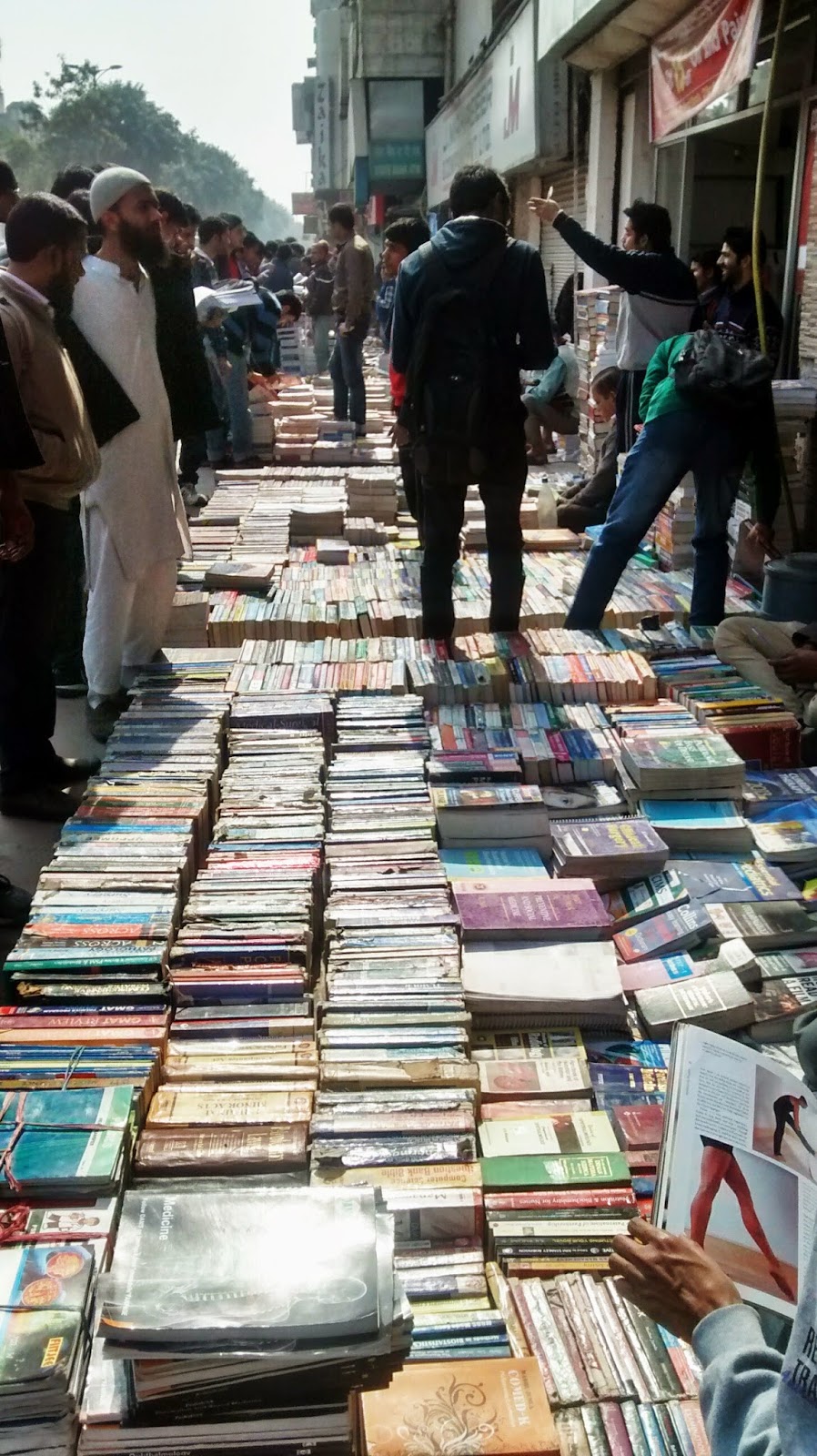
The Sunday Book Market
Ever wonder what happens to your old text books, dime
novels, study guides, and worn-out classics after you’re done with them?
Perhaps donated them to a school book fair, dropped them off at Housing Works
or sold them back to Barnes and Nobles? Well, friends, I think I’ve found the
answer.
They end up on the streets of Delhi’s Sunday afternoon book
market in the old city. A friend who is an avid reader brought me here last
Sunday and I was amazed to see blocks and blocks of book-sellers hawking the
books of yesteryear (and, to be fair, a couple of new releases as well,
carefully displayed in plastic wrapping). Each bookseller seemed to have his
own specialty but I was surprised to see just how many old text-books and study
guides were on offer; it felt like these were the bulk of the books being sold.
I have no idea if a person looking for a specific
text book would be able to find it, but I’m pretty sure if you could find a
text book on any given subject you were interested in: organic chemistry, US
federal law, basic algebra; early modern European history, SAT guides, etc.
There was also a healthy offering of drug store romance
novels with pec-a-licious Fabio adorning the cover, not to mention an generous
assortment of self-help books, cook books, and, of course, a whole slew of
books in Hindi. Not to be outdone, there were also several hawkers with
carefully-curated collections of novels and literally classics. I myself
pounced on a beat-up copy of Holy Cow
(a book about an expat struggling in India that I’d been wanting to read) for
only $1.50 while my friend picked up a slightly-charred copy of The Little Prince (the bottom left
corner was burned away, but the book itself was perfectly legible) for only
$0.50. She also engaged in a fierce bout of bargaining with one vendor for 10
titles she wanted to buy, but ultimately walked away when the vendor refused to
lower his price more than $4 per book. (For that price, she says, she can buy
the books new.)
One other little fun bit I noticed about the book market—at some
places they even sold books by weight! (I bet those vendors don’t do much trade
in law texts, though—damned heavy things.)
[What a bargain! Best-sellers for only Rs. 200 per kilo!]
Tuesday, February 3, 2015
The Red Fort
After 10 months in Delhi I still hadn't managed to make it up to the Red Fort which is in the chaotic old city section of Delhi, but a few weeks ago I decided to finally shake off my procrastination and make the trek. And the Red Fort is monumental: giant in size, rich in history, and chock-full of interesting photo opportunities.
Here’s what Wikipedia has to say about the Red Fort: “It was the residence of the Mughal emperor of India for nearly 200 years, until 1857. In addition to accommodating the emperors and their households, it was the ceremonial and political centre of Mughal government and the setting for events critically impacting the region…. The Red Fort is considered to represent the zenith of Mughal creativity under Shah Jahan. Although the palace was planned according to Islamic prototypes, each pavilion contains architectural elements typical of Mughal buildings, reflecting a fusion of Timurid, Persian and Hindu traditions…. It was designated a UNESCO World Heritage Site in 2007 as part of the Red Fort Complex….The Red Fort is an iconic symbol of India.”
Meh.
Let me explain. I'm not trying to say that the Red Fort enjoys unearned fame and tourist ticket money--I think it is probably $5 and an hour well spent. But there was nothing to me (other than size) that really set it apart from all of the other grandiose Mughal-era buildings this fine city has on display. Call me jaded or palace/fort/tomb weary, I guess, but after a while lots of this stuff starts to look a bit similar. Even if it is an "iconic symbol of India."
Actually, I err. There is something that sets the Red Fort apart from other tourist sites around Delhi—and that is crowds. I mean, many of Delhi’s sites are fairly well attended, but the Red Fort, being an A-list attraction literally has the looooooongest lines to get in. Like, I bet folks have to wait on the ticket line for at least an hour.
Unless you’re a foreigner, of course. One of the delights(?) of being a blond white-skinned chick at an A-list Indian tourist attraction is that you get dragged out of the crazy long line by some official-looking security guard, who then marches you past all of the plebeians into a special VIP line. I say a special VIP line, but who am I kidding? I’m pretty sure it’s just the white persons' line. Actually, maybe an Indian with lots of money could go to this line too. Or a brown-skinned person flashing a foreign passport—I’ve just never seen anyone but a white person in the VIP line. Yep, that’s white privilege, right there.
I always feel super guilty when I skip the locals line to go into the VIP line because once there I promptly refuse to pay the exorbitant foreigner’s fee (which is usually about Rs. 300, versus the Rs 10 that Indians pay to get in) and instead flash my residence card. So, I get to skip the line AND I get to pay the Indian rate. Yep, I feel pretty guilty about it—but I still do it. You see, I’m really a terrible person.
Anyway, here are some more nice pictures that I took of the Red Fort, for those who may not be as palace/fort/tomb weary as I am. Enjoy!
Pigeon racing
Last Sunday I went to watch a pigeon race.
What is a pigeon race, perhaps you ask? Well, my dear friends,
let me tell you: pigeon racing is one of the most bizarre and awesome, grandiose
and subtle sports I have ever witnessed. It’s an old pastime of Old Delhi, a
tradition which is slowly dying out—though, as I happily can report, still
robustly alive in certain parts of this city. Pigeon racing is part animal
husbandry and soothsaying, part adrenaline-laced excitement, and part lazy Sunday
morning social hour. It takes an
immensely talented trainer, a wealthy owner, a cheering partisan crowd, and 85
clever pigeons. It is glorious.
I had first read about this dying sport in Twilight in Delhi, a novel published in
1940 about the pre-WWI Delhi of the author’s childhood. The book is
magnificently evocative of the Muslim community living in the old part of the
city, and one of the main pastimes of the book’s grand-patriarch is pigeon
keeping and racing. This grand patriarch takes his pigeons out flying every
morning and occasionally triumphs over his frenemies by having his pigeons “capture”
members of their flocks. I was intrigued
by the book’s discussion about this hobby, but had little conception of what
this might look like in reality. How could a person train pigeons to fly in a
pre-designated path…and return home at a set time? How do you capture pigeons from
a neighbor’s flock? How, really, do pigeons race?
For the last 6 months or so I’ve been keeping my eye open
for information about this world of pigeon racing, so you can imagine my
delight when my favorite Delhi walking guide announced she was leading an excursion
to a pigeon race last weekend. Naturally, I signed up—perhaps one of the few
times in my life I’ve happily woken up at 7:30am on a Sunday.
[Rooftops of Old Delhi--before the masses arrive]
The first thing to know about pigeon racing is that it
happens in a world onto itself; the rooftops of Old Delhi become the arena. Old
Delhi is itself a wondrous part of the city—cluttered, labyrinthine,
dilapidated, chaotic, colorful and in every single way an assault on all senses.
But once you find your way up to the rooftops it’s a whole different scene. Quiet, calm and peaceful (or, at least until
the racing gets started). Yes, quiet, calm, and peaceful—but not empty. Because
on the morning of a touted pigeon race (and, I’m told, on most Sunday mornings,
anyway), the rooftops all across this portion of the city are crammed with
eager onlookers. Literally, a 360 degree turn reveals rooftops packed with men,
young and old, enjoying chai, chatting, and waiting for the games to begin. I
suspect that the entire male population of Old Delhi ascends to the rooftops
for a few hours each Sunday morning.
[The crowd gathers on our roof. The guy in red is the pigeon owner]
[Crowds on other roofs, hooting and a'hollering.]
All male, of course. The only female, other than the few that
had come with our group, who I could discern in the crowd was the 9-year-old
daughter of the flock owner whose roof we were on. (After the race was over and
we descended back towards the street we stopped into the owner’s apartment,
just a floor below the rooftop, and met his wife. She had remained in the house
during the entirety of what seemed to me to be the most exciting sporting event
this side of the Superbowl, despite the fact it was her family’s flock that was
competing!)
Anyway, as I understand them, the rules of pigeon racing are
pretty simple. Competitors are scored based on:
- How far their flocks fly within the allotted time. (For the race I witnessed, it was a half hour). Apparently there are official scorers sitting of roof decks all over the city who can confirm whether or not the flocks reach a certain neighborhood. Note though, that pigeons don’t just fly out for 15 minutes and then fly back for 15 minutes. Nope—within that 30 min span they make multiple circles around their home roost and it’s their furthest circle that seems to be scored.
- If the flocks come home and roost within the allotted time. I didn’t get the sense that this was scored strictly, but if the competition is 30 minutes long and your pigeons disappear for 2 hours then I imagine you get penalized or disqualified for this.
- If all of your pigeons come back. The competitive flocks are all 85 pigeons, so if only 83 end up coming home, your points get docked. In fact, once pigeons get released there is a lot of caterwauling from enemy rooftops as competitors are trying to distract pigeons from listening to their owners’ call and returning home.
- If you capture any enemies’ pigeons. The competition I watched only had one flock released at a time, but in other competitions multiple flocks are released. The idea is that if your flock flies into a competitor’s flock and their pigeons get confused and come home with yours you get to keep the pigeons you’ve “captured” and then sell them back to the original owner. I asked how much a captured pigeon gets sold back for and the flock owner who was chilling with us told me that it could be anything. I guess it really depends on how much you dislike your competition![These are the two pigeon trainers]
Now, I must admit that how
one trains a pigeon to fly in ever increasing circles before gently coming back
to roost remains a mystery to me. But clearly the pigeon trainers have a
certain kind of mastery over these birds—even a novice bird-watcher like myself
can see that the pigeons react differently based on the call being made by
their trainer. I could myself could make out three kinds of calls: the caterwaul
(in which all members on the rooftop in question join in) which seemed meant to
drive the pigeons back out on their rounds; the shrieking whistle; and the soft
coo, which along with handfuls of feed thrown into the air, coaxed the pigeons
back home.
I was told also that the pigeon feed is premium grade A human
consumable stuff—clearly these birds are well looked after. In fact, the
whole process of pigeon racing is really expensive—probably at $6000 a year
(which is a lot of money in India—maybe
almost a yearly middle class salary). But the prize money is not to be snuffed at—in
the tournament I witnessed first place was Rs 11,000, which is more than an
average autorickshaw driver makes in a month. I don’t totally understand all of
the finances of it, but the flock owner told us that Old Delhi hosts several informal
“clubs” of pigeon racers. Members of the same club share pigeon trainers and
won’t compete amongst themselves, but all club members will stake a particular
member to compete in any given competition—maybe the prize money is also
likewise shared?
[Some well-fed pigeons]
[In addition to the prize money, the winners also won these awesome trophies!]
As with almost any sporting event, cultural event, or um,
just event, period, in India, there also seemed to be an almost spiritual
aspect to the racing. It was explained that this particular race was in honor
of an recently-deceased grandfather who had been prominent in the pigeon racing
world, and before the racing began a sort of dirge was sung for this
grandfather.
Anyway, the race itself was very exciting. As you can see
from the below video—everyone gets really into all of the hooting and
hollering. The owner and the trainers themselves were getting so hysterical I
thought someone was going to have a heart-attack. But apparently they knew
their business—all of their pigeons
came back on time, having traveled, at their furthest, about 4 kilometers.
And then they let me hold the pigeons!
Subscribe to:
Posts (Atom)